1. Principal Authority Governing Trade
The competent authority for foreign trade in Hungary is the Ministry of Foreign Affairs and Trade.
2. Trade Regulations
Hungary's trade policies and regulations are generally aligned with those of the European Union (EU). The primary trade-related laws and regulations include: Government Decree on Goods Trading, Services, and the Valuation of Cross-Border and Critical Materials (abbreviated as the Trade Law) (Government Decree 52/2012 (11.28); Government Decree 9/2023 (1.17)), EU Regulation on Protection against Dumped Imports from Countries not Members of the European Union (Regulation (EU) 2016/1036), Act Amending the Foreign Exchange Liberalisation and Related Laws (Act XCLIII of 2001), Act on the Implementation of Union Customs Code (Act CLII of 2017), Act on the Functions of the Hungarian Revenue and Customs Service (Act CXII of 2010), Government Decree on the Import and Export of Dual-Use Goods (Government Decree 13/2011 (11.22), among others, as well as Regulation (EU) 2022/2560 on Foreign Subsidies.
The EU's International Procurement Instrument (Regulation (EU) 2022/1031) came into effect on August 29, 2022, aiming to "encourage" reciprocal opening of protected foreign public procurement markets to EU economic operators
The EU's "Foreign Subsidies Regulation" [Foreign Subsidies Regulation (FSR), Regulation (EU) 2022/2560] came into effect officially on July 12, 2023. According to the regulation, starting from October 12, 2023, enterprises in the EU that participate in merger transactions or public procurement tenders and have received foreign subsidies within the previous three years and meet the relevant reporting thresholds must make a pre-notification to the European Commission. They can only complete the merger transaction or win the public procurement contract after obtaining the review and approval from the European Commission. On July 26, 2024, the European Commission issued a working document in the form of questions and answers regarding Article 4(1), Article 6, and Article 27(1) of the FSR regulation, addressing issues such as how to determine whether foreign subsidies have distorted the EU internal market.
3. Relevant Provisions on Trade Administration
Hungary implements the unified EU trade policy, allowing goods and services to be freely imported and exported within the EU. According to the newly revised 2023 Trade Decree, the import and export of equipment (such as knives and scabbards, daggers, bows and arrows, self-defense spray, etc.), radioactive substances, explosives and pyrotechnic products, bulletproof vests, gas masks, security paper, printing paper, dual-use products, etc., that pose a threat to public safety must obtain a license from the Budapest Főváros Kormányhivatala. The National Institute of Pharmacy and Nutrition (OGYÉI) is responsible for approving the import and export of narcotic drugs and psychotropic substances.
In matters related to public order, public morality, public safety, the protection of human, animal and plant life and health, and the safeguarding of national property, the Hungarian Government may adopt corresponding measures without being constrained by the EU internal market and import regulations.
4. Inspection and Quarantine of Imported and Exported Commodities
In accordance with the EU Common Agricultural Policy and other regulatory requirements, Hungary conducts import quarantines on food, animal, and plant products. Products from third countries (including Hungary) may only be introduced into the EU if they comply with animal health, plant health, and food safety regulations. Hungary requires import documentation for animal and plant products, food, and feed to be completed and submitted using the European Commission's online system, TRACES (Trade Control and Expert System). Laboratories in Hungary providing inspection and quarantine services can be found on the website of the National Accreditation Authority of Hungary (NAH): https://nah.gov.hu/kategoriak/.
The Food Chain Regulation Department of the Ministry of Agriculture of Hungary is responsible for international trade activities in animal health, animal protection, plant health, plant protection, plant products, ragweed issues, and organic agriculture. Additionally, it conducts inspection and certification tasks in the fields of vegetables and fruits, feed hygiene, feed safety and quality, food hygiene, food safety, and alcohol certification, among others. For details, see: https://elemiszorlancor.kormany.hu/allamtapasztakas-szervezete.
The National Food Chain Safety Office of Hungary (nébih) is responsible for supervising and protecting food safety in Hungary. The import procedures and inspection and quarantine requirements for animal and plant products, food, and feed can be found on the official website: https://portal.nebih.gov.hu. For information on using the TRACE system, see: https://portal.nebih.gov.hu/traces.
The important websites for plant, animal and food inspection and quarantine are as follows:
Requirements for carrying items when traveling to EU member states: https://ec.europa.eu/youreurope/citizens/travel/carry/meat-dairy-animal/index_en.htm#inline-nav-4
Explanation of the ban on animal-derived products: https://portal.nebih.gov.hu/-/szigoru-szabalyozas-a-poggyaszban-behozott-elelemiszerekrevonatkozo
Measures regarding the import of certain agricultural products from Hungary: https://njt.hu/jogszabaly/2024-80-20-2
5. Customs Administration Rules and Regulations
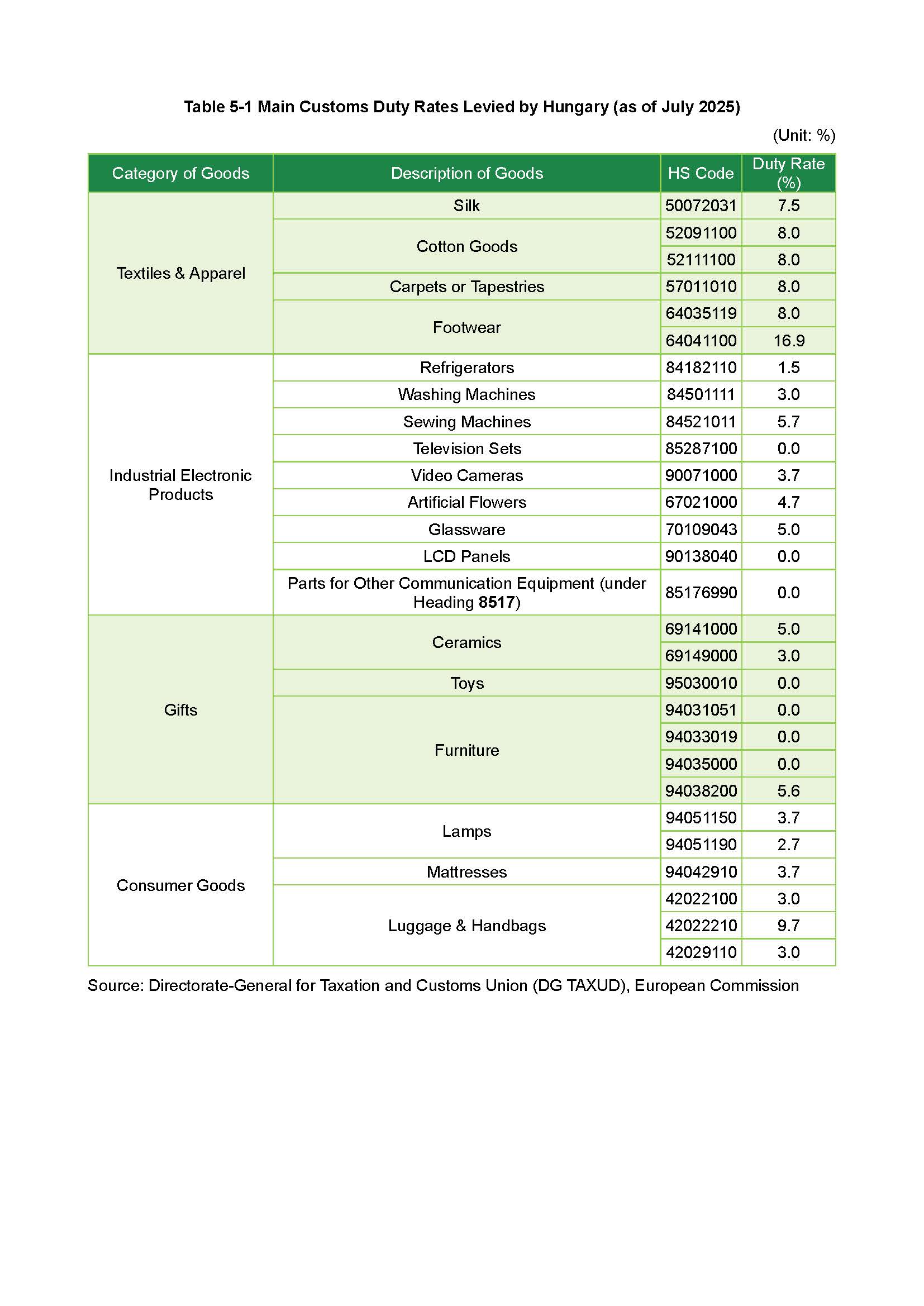
The competent customs authority in Hungary is the National Tax and Customs Administration of Hungary (NemzetiAdó-ésVámhivatal,NAV). Hungary enforces EU customs laws and regulations, including the EU Tariff Standards Act, Customs Statistics System, EU tariff rates, and Customs Exemption Decree. Once customs clearance has been completed in any Member State of the EU, goods entering Hungary are exempt from customs duties.
[Customs Broker] In accordance with Chapter 5 of the EU Customs Tariff, investors and operators in Hungary may engage a professional customs broker to handle customs procedures.
[Certificate of Origin of Goods] There are two types of certificates of origin for goods exported from Hungary. The first type, applicable under non-preferential rules of origin, is primarily used to circumvent certain restrictive regulations when exporting products to third countries. This certificate of origin is issued by the regional Chambers of Commerce and Industry in Hungary. Detailed regulations are available on the websites of the Hungarian Chamber of Commerce and Industry (HCCI) and the respective regional Chambers of Commerce and Industry. Second, the certificate of origin under the preferential rules of origin is primarily utilized to enable products exported to third countries to benefit from preferential treatment. For specific details, please consult the bilateral agreements between Hungary and the respective third countries. This certificate of origin is issued by the NTCA.
The website of the Hungarian Chamber of Commerce provides an introduction to the certificate of origin: https://mkik.hu/szarmazasi-bizonyitvany-hitelesitese
The website of the Budapest Chamber of Commerce offers an introduction to the certificate of origin: https://www.bkik.hu/szarmazasi-bizonyitvany-szamla-egyeb-okmany-hiteleitese
The website of the Hungarian Customs provides an introduction to the preferential origin rules: https://www.nav.gov.hu/szamarzasi/EK-szabalyrendszer/
[Certification and Inspection] Information on Hungary's accredited certification bodies and testing laboratories, certification processes, fees, etc., can be found on the website of the NAH: https://nah.gov.hu/hu/oldal/mi-az-akkreditalas/.
[Customs Duties] As of July 2021, the EU has imposed value-added tax (VAT) on all parcels entering EU customs territory. The European Commission published the proposal titled "EU Customs Reform: A data-driven vision for a simpler, smarter and safer Customs Union" in May 2023, which aims to eliminate the tariff exemption for imported goods valued below EUR 150. It is currently seeking to expedite the adoption of this measure.
EU tariff rate inquiry: https://ec.europa.eu/taxation_customs/dds2/taric/taric_consultation.jsp?Lang=en.
Disclaimer:The above laws and regulations are translated from the Institute of International Trade and Economic Cooperation of the Ministry of Commerce of the People's Republic of China, the Economic and Commercial Office of the Chinese Embassy in Hungary, and the Department of Foreign Investment and Economic Cooperation of the Ministry of Commerce. Please refer to the latest laws and regulations issued by the relevant units.
